
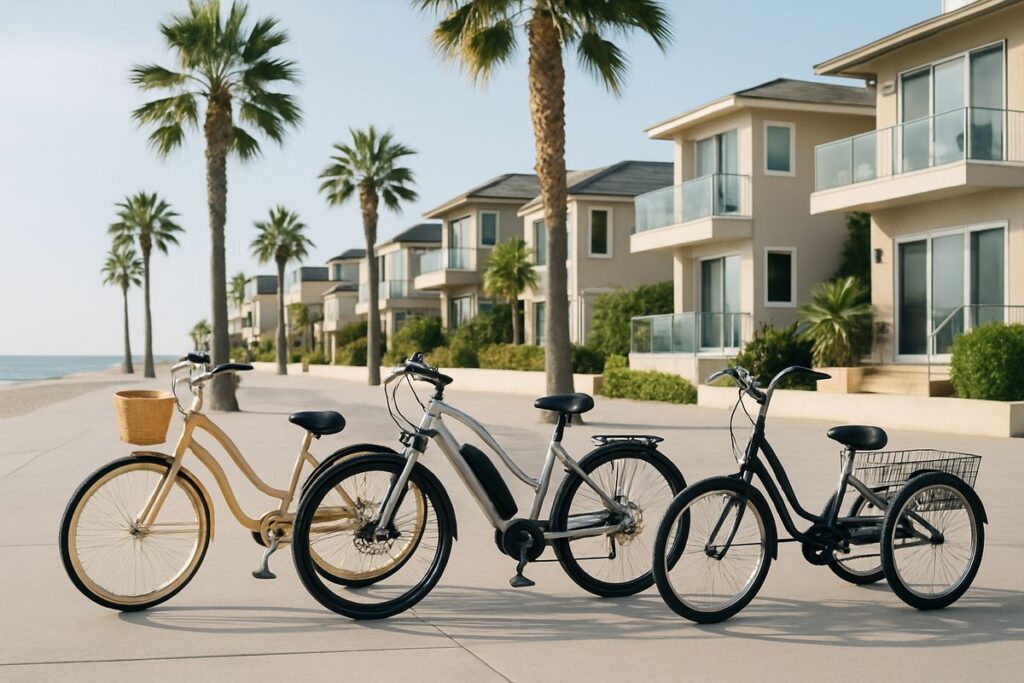
Adult bike size sounds simple until you’re staring at rental photos thinking, “That looks about right,” then ending up with a bike that feels terrible ten minutes into the ride. The truth is, adult bike size is not just one number, and getting it right can make the difference between an easy cruise and a sore, awkward afternoon.
What adult bike size really means
Adult bike size usually starts with frame size, but that’s only the first layer. The real fit comes from a mix of frame size, your inseam, saddle height, reach to the handlebars, and the kind of bike you plan to ride.
Here’s the thing: two bikes can both be labeled “medium” and feel completely different. One might put you upright and relaxed, like sitting in a comfortable patio chair. Another might stretch you forward enough that your shoulders and hands start complaining before you even reach the next corner.
That matters even more on vacation. If you’re riding around Naples neighborhoods, heading toward the beach, or taking a relaxed spin through Marco Island, comfort usually matters a lot more than squeezing out speed. The right adult bike size should let you pedal smoothly, stop confidently, and enjoy the ride instead of fiddling with the bike every few minutes.
How adult bikes are sized
Most adult bikes are sized in one of three ways: inches, centimeters, or general sizes like small, medium, and large. Mountain bikes often use inches or letter sizes. Road bikes usually use centimeters. Hybrids, cruisers, comfort bikes, and many e-bikes often stick with S, M, and L.
That sounds tidy, but bike sizing isn’t standardized the way shoe sizing is. A 17-inch mountain bike is not automatically the same fit as a medium comfort bike. Geometry changes everything. Frame angles, top tube shape, wheel size, handlebar height, and overall design all change how the bike feels under you.
If you want a broader starting point before comparing categories, a good way to read general size ranges fast can help, but the bike type still has the final say.
Frame size vs. actual fit
Frame size tells you where to begin, not where to stop. It’s the bike version of knowing your jeans waist size but still needing to try on the cut.
A bike’s labeled size mostly reflects the frame, usually the seat tube length or a brand’s own sizing system. Actual fit depends on more than that. Saddle height changes how your legs move. Handlebar position changes how your back, shoulders, and wrists feel. Top tube length changes whether you feel nicely supported or too stretched out.
Even two road bikes with the same 54 cm label can feel surprisingly different. Same-size road bikes can vary a lot by brand. That’s why a chart gets you close, but comfort checks finish the job.
Why bike type changes the size feel
Bike type changes your posture, your reach, and how stable the bike feels when you start, stop, and turn.
A cruiser or comfort bike usually puts you upright, with a shorter reach and a more relaxed feel. That’s ideal for easy rides, beach access points, and neighborhood cruising. A hybrid sits somewhere in the middle, still comfortable but a little more efficient if you want to cover more ground. A road bike puts you lower and longer, which can feel great for fitness rides but less friendly if you just want to enjoy the scenery. Mountain bikes often feel more compact and maneuverable, with extra standover room. E-bikes follow many of the same sizing rules, but because they tend to be heavier, fit and control matter even more.
That’s one reason e-bike adoption among adults 35 to 55 keeps growing. Extra power helps, but only if the bike still feels easy to handle.
How to measure yourself for the right bike
Before you reserve anything, measure your height and your inseam. Height helps. Inseam helps more.
Your inseam is the distance from your crotch to the floor. It tells you much more about bike fit because it relates directly to standover clearance and saddle height. Two people can both be 5’8″ and need different bikes because one has longer legs and the other has a longer torso.
Use a wall, take off your shoes, and keep it simple. Stand straight with your back against the wall. Measure your full height. Then measure your inseam carefully. Write both numbers down so you can compare them to the right chart for the kind of bike you actually want to ride.
The quick inseam method
This is the easy at-home trick that gets you much closer than guessing from height charts alone.
Stand with your back against a wall and your feet about 6 inches apart. Slide a hardcover book or similar object upward between your legs until it presses firmly, like a bike saddle would. Keep the book level, mark the top edge on the wall, then measure from the floor to that mark. That number is your inseam.
It’s not fancy, but it works well enough for rentals and pre-trip planning. If you’ve ever guessed your size based only on height and ended up feeling cramped or overextended, this is usually the missing piece.
Simple sizing formulas that help
Formulas are useful, but they are not magic answers. Think of them like using a recipe for rice in a new kitchen. It gets you close, then you still taste and adjust.
For saddle height, one common starting point is the LeMond method, which uses inseam × 0.883. Another traditional formula uses inseam × 1.09, but some fit guidance has found that method can be less reliable in practice. For most casual riders, the easiest real-world test is the heel check: put your heel on the pedal at the bottom of the stroke. Your leg should be almost straight, without your hips rocking side to side.
When you pedal normally with the ball of your foot, your knee should then have a slight bend at the bottom. That slight bend matters. Too little bend usually means the saddle is too high. Too much bend usually means it’s too low.
Adult bike size charts by bike type
Charts are helpful because they narrow the field fast. Just make sure you’re looking at the chart for the right bike category. A road chart is not a hybrid chart, and an e-bike chart is not automatically the same as a cruiser chart.
The ranges below are rough starting points, not iron laws.
Road bike size chart
Road bikes often use centimeter frame sizes and usually put you in a more stretched-out position. If you want a faster, more fitness-oriented ride, this is the category that leans that way.
| Rider Height | Inseam | Road Bike Frame |
|---|---|---|
| 5’0″ to 5’3″ | 27″ to 29″ | 47 to 49 cm |
| 5’3″ to 5’6″ | 28″ to 30″ | 50 to 52 cm |
| 5’6″ to 5’9″ | 30″ to 32″ | 53 to 55 cm |
| 5’9″ to 6’0″ | 31″ to 33″ | 56 to 58 cm |
| 6’0″ to 6’3″ | 33″ to 35″ | 58 to 60 cm |
| 6’3″ to 6’6″ | 35″ to 37″ | 61 to 63 cm |
Hybrid and comfort bike size chart
For sightseeing, casual rides, and paved paths, hybrids and comfort bikes are usually the sweet spot. You get a more upright posture, easier handling, and less pressure on your hands and lower back.
| Rider Height | Inseam | Hybrid or Comfort Size |
|---|---|---|
| 4’10” to 5’2″ | 25″ to 28″ | Small |
| 5’2″ to 5’6″ | 27″ to 30″ | Small to Medium |
| 5’6″ to 5’10” | 29″ to 32″ | Medium |
| 5’10” to 6’1″ | 31″ to 34″ | Large |
| 6’1″ to 6’4″ | 33″ to 36″ | XL |
Hybrid bikes are getting more attention for exactly this middle-ground role, with hybrid growth projections pointing to how many adults want one bike that feels comfortable and versatile.
Mountain bike size chart
Mountain bikes usually use inches or letter sizes, and they often feel smaller and more maneuverable than road or hybrid bikes. Extra standover room is common, which can make them feel more confidence-friendly.
| Rider Height | Inseam | Mountain Bike Frame |
|---|---|---|
| 5’0″ to 5’4″ | 26″ to 29″ | 13″ to 15″ / Small |
| 5’4″ to 5’8″ | 28″ to 31″ | 15″ to 17″ / Medium |
| 5’8″ to 6’0″ | 30″ to 33″ | 17″ to 19″ / Large |
| 6’0″ to 6’3″ | 32″ to 35″ | 19″ to 21″ / XL |
| 6’3″ to 6’6″ | 34″ to 37″ | 21″ to 23″ / XXL |
E-bike size chart
Adult e-bike sizing still matters, maybe even more than you expect. A motor can help with effort, but it can’t fix a bike that feels awkward or hard to control.
| Rider Height | Inseam | E-Bike Size |
|---|---|---|
| 4’11” to 5’3″ | 26″ to 29″ | Small |
| 5’3″ to 5’7″ | 28″ to 31″ | Medium |
| 5’7″ to 6’0″ | 30″ to 34″ | Large |
| 6’0″ to 6’4″ | 33″ to 36″ | XL |
In the U.S., e-bikes made up 30% of bicycle revenue in 2024, which says a lot about how common this choice has become for adults planning longer, easier rides.

How to tell if a bike fits once You’re on it
A chart gets you in the ballpark. The first few minutes on the bike tell you if you picked the right seat.
Pay attention to four things right away: standover clearance, saddle height, reach to the bars, and overall comfort. If one of those feels off immediately, don’t talk yourself into “getting used to it.” More riders are moving away from that whole “I’ll get used to it” mindset, and honestly, that’s a good thing.
Check your standover clearance
Stand over the bike with both feet flat on the ground. On a traditional road bike, about 1 inch of clearance is a good target. On a mountain bike, about 2 inches is better. If the bike has a step-through frame, this test matters less because the frame is designed to make mounting and stopping easier.
This check is mostly about confidence and safety. If you stop suddenly, you want room to step down cleanly, not slam into the top tube.
Check your saddle height
This is the easiest practical fit test for most adults. At the bottom of the pedal stroke, your knee should still have a slight bend.
If the saddle is too low, pedaling feels cramped and your knees may start to ache in the front. If the saddle is too high, your hips may rock side to side, your toes may point down, and you may feel like you’re reaching for the pedals. A common target is a 25 to 35° knee bend, but you do not need a protractor on vacation. You just need smooth pedaling and stable hips.
Small changes matter here. Even a few millimeters can change how the bike feels.
Check your reach and riding position
Your shoulders, hands, and lower back usually tell you pretty quickly when the reach is wrong.
If you feel too stretched out, you’ll notice pressure in your hands, tight shoulders, or a sense that you’re always reaching forward. If you feel too cramped, your knees may come up high, your elbows may feel bunched, and the whole bike can feel twitchy. For casual riding, a slightly more upright setup usually wins.
That’s especially true if your trip includes easy neighborhood loops, beach stops, or a group riding day with kids and slower cruisers. In that kind of setting, comfort and easy handling beat aggressive posture every time.
Common adult bike sizing mistakes
Most sizing mistakes are simple. The annoying part is how quickly you feel them once you start riding.
Choosing by height alone
Height charts are useful, but they leave out too much. If your legs are longer than average, you may need more saddle height and different standover room than someone your exact height. If your torso is longer, reach becomes a bigger issue.
That’s why inseam is such a better guide than height alone. It gives you a closer match to the bike’s actual setup needs.
Sizing up “just in case”
A bike that’s too big is harder to control and less comfortable, full stop.
Plenty of people size up because they assume bigger means roomier. Usually it just means you’re stretched out, less stable at stops, and stuck with fewer adjustment options. Slightly smaller is often easier to fine-tune with saddle height and seat position. Slightly bigger is much harder to fix.
Ignoring seat and handlebar adjustments
Not every uncomfortable bike is the wrong frame. Sometimes it just needs a quick tweak.
A seat that’s a little too low or too high can make a decent bike feel bad. A small handlebar adjustment can improve reach. But there’s a limit. If you need the saddle slammed all the way down, or raised to the max, or you still feel too long on the bike after basic adjustments, it’s probably the wrong size, not a setup issue.
Picking the right fit for your trip, comfort level, and group
The best bike for your trip is not always the fastest or fanciest option. It’s the one that matches how you actually plan to ride.
Best fit for casual sightseeing
For easy sightseeing, upright comfort bikes, cruisers, and relaxed hybrids usually feel best. You get a simpler riding position, easy starts and stops, and a better view of what’s around you.
That makes a big difference if you’re riding near Lowdermilk Park, rolling through quiet Marco Island neighborhoods, or stopping often for beach access, photos, or lunch. If you’re comparing local options, it helps to look at different ride styles available on the island instead of focusing only on price or bike category names.
Best fit if you want extra help from an e-bike
An e-bike makes sense when the ride is longer, the weather is hot, the route includes bridges, or your group has mixed fitness levels. It’s also a great choice if you want to keep up without turning the day into a workout.
That’s a big reason e-bikes keep showing up in adult travel plans. You still need the right size, though, because a heavier bike needs to feel stable when you start, stop, and turn.
Best fit for couples and families riding together
When you’re riding with a partner, kids, or a mixed-speed group, the “best” bike is often the one that keeps everybody comfortable and moving at the same pace.
That usually means upright positions, confidence at low speeds, and bikes that are easy to get on and off. Speed matters less. Smooth starts, easy stops, and comfort matter more. If part of your plan includes sharing the experience more than covering miles, even options like riding side by side on one bike can make more sense than chasing a sportier setup.
Adult bike size FAQs
Is it better to size up or down on an adult bike?
Usually, size down if you’re between two sizes. A slightly smaller bike is easier to adjust and control, while a bike that’s too big is harder to fix and usually feels worse at stops.
Does adult bike size matter on a beach cruiser or rental bike?
Yes, even on relaxed bikes. Cruisers and rental bikes are more forgiving, but fit still affects comfort, pedaling, and confidence. A poor fit can still leave your knees cramped or your reach awkward.
Can two adults of the same height need different bike sizes?
Absolutely. Inseam, arm length, flexibility, and riding style can all change the right fit. Same height does not mean same bike.
What if you’re between two adult bike sizes?
Use your riding style as the tie-breaker. If you want a more upright, confidence-friendly ride, go a bit smaller. If you want a more stretched-out, fitness-focused position, the larger option can work if the standover and reach still feel right.
A simple way to get the right fit before you book
Here’s the simplest rule: measure your height, measure your inseam, compare both to the chart for the bike type you actually want, then choose comfort over guesswork.
If you do one thing before reserving a bike, e-bike, or cruiser for your trip, make it this: measure your inseam today. It takes two minutes, and it’s the easiest way to avoid booking a bike that looks fine online but feels wrong the second you start pedaling.