
If you’re wondering are golf carts street legal in Naples and Marco Island, the short answer is yes, but only in a pretty narrow way. The vehicle itself matters, the exact roads matter, and local rules matter more than most vacationers expect, especially when you’re picturing a quick beach run instead of reading traffic ordinances.
The Short Answer: Are Golf Carts Street-Legal in Naples and Marco Island?
Yes, a golf cart can be legal on certain public roads in Florida, including parts of Naples or Marco Island, but only when that road is specifically approved for golf cart use and the setup matches the law. That means you cannot assume a cart is fine just because the street feels slow, residential, or vacation-friendly.
For trip planning, that’s the part that matters most. If your goal is simple, short hops around a neighborhood, resort area, or approved local route, a cart can be a great fit. If your plan involves crossing town, mixing beach stops with shopping, or using busier roads, the answer changes fast.
Why This Gets Confusing Fast
A lot of rental listings blur together three different things: a regular golf cart, a street-legal cart, and an LSV. On a vacation website, those can sound interchangeable. Legally, they are not.
That matters before you book. The wrong assumption can turn an easy plan into a frustrating one, especially if you arrive thinking your cart can go from your condo to dinner to beach access and then find out one stretch of road breaks the route.
A Golf Cart Is Not the Same Thing as an LSV
Florida defines a golf cart as a vehicle designed for golf course use that cannot go over 20 mph. An LSV, or low-speed vehicle, is different. It goes faster than 20 mph but no more than 25 mph and falls into a stricter legal category.
Think of it like the difference between flip-flops and sneakers. Both get you moving, but only one is built for more demanding ground. A traditional golf cart is for limited, approved routes. An LSV is made for broader street use, though still not everywhere.
“Street-Legal” Is a Real Legal Category, Not a Casual Label
“Street-legal” is not just a catchy rental phrase. It means the vehicle meets actual legal requirements for road use. If a cart is really an LSV, or a converted cart that now counts as one, it needs to comply with registration, insurance, equipment, and licensing rules.
So if a listing says “street-legal golf cart,” the useful follow-up is not the label itself. The useful follow-up is what category that vehicle actually falls into.
When a Golf Cart Can Be Driven on Public Roads in Florida
Florida’s baseline rule is simple: regular golf carts can be driven only on roads designated for golf cart use, and those roads generally need a posted speed limit of 30 mph or less. You can also see limited legal crossings in certain places, but that is not the same thing as having full access to the whole street network.
Roads a Traditional Golf Cart Can Usually Use
Traditional golf carts can usually use designated local roads and certain approved crossings. Florida also allows crossing some road segments at intersections tied to golf-cart-approved routes, golf courses, or mobile home parks, especially where signs show golf carts share the roadway.
In real life, that usually means very short public-road connections, not broad freedom to roam. A cart can make sense in a contained area. It usually does not make sense as your default transportation plan across a whole vacation zone.
Where a Golf Cart Cannot Just Be Driven
Here’s the catch: a calm-looking local street is not automatically legal for golf cart use. Tourist areas are full of roads that feel casual but still are not designated golf cart routes.
That’s why route planning matters more than vibe. If one block of your path is not approved, the whole idea falls apart. If you’re comparing options, it helps to look beyond the cart itself and think about what kind of Naples ride actually fits your plans.
What Changed Under Florida’s Newer ID Rules
Florida tightened the rules in 2023. As of October 1, 2023, anyone under 18 operating a golf cart on public roads needs a learner’s permit or driver’s license. If you’re 18 or older, you need a valid government-issued photo ID.
That catches visitors off guard all the time because golf carts feel informal. On public roads, they are not informal anymore.
What Makes an LSV More Flexible Than a Golf Cart
A lot of people searching for a “street-legal golf cart” are actually looking for an LSV. That’s the version built for more real-road use, even though it still has limits.
Where an LSV Can Legally Drive
An LSV can legally operate on streets with posted speed limits of 35 mph or less. That gives you more flexibility than a standard golf cart, but it still does not mean “anywhere in Naples” or “all over Marco Island.”
One faster road in the middle of your route can still block the plan. That’s why the best approach is to map the exact path before booking, not after check-in.
What an LSV Must Have to Be Legal
LSVs need title, registration, insurance, required safety equipment, and a valid driver license for the operator. Florida also requires PIP and PDL insurance. In plain English, PIP helps cover injury-related costs for the driver, and PDL covers damage you cause to someone else’s property.
That sounds more like a car because, legally, it is much closer to one. If you want a simpler vacation option, sometimes an electric ride with fewer route surprises ends up being the easier choice.
If a Cart Has Been Modified, It May No Longer Count as a Golf Cart
This is one of the biggest gray areas. A cart that has been modified for higher speeds or road-use compliance may no longer count as a basic golf cart. It may now count as an LSV, which changes everything about what paperwork and equipment are required.
In other words, a conversion is not just an upgrade in comfort. It changes the legal category.
What to Check Specifically in Naples and Marco Island
State law is only the first layer. In practice, city rules, private community rules, and rental-property rules can be stricter. For vacation planning, that local layer is often the one that decides whether a cart is useful or a hassle.
Naples: Check City Routes, Neighborhood Access, and Rental Rules
In Naples, do not start with “Can I rent a cart?” Start with “Where exactly am I staying, and what exact roads connect it to the places I want to go?” That means looking at your lodging, nearby beach access, shopping stops, and dinner spots one by one.
Some local guidance has noted stricter Naples limits, including neighborhood-specific use and bans in certain areas such as city beaches. The practical point is simple: confirm the route first, then choose the vehicle.
Marco Island: Great for Short Local Trips, but Only on Approved Streets
Marco Island is the kind of place where a cart sounds perfect, and sometimes it really is. A short ride from your rental toward a beach access point or over to a casual dinner near Collier Boulevard can feel easier than loading everyone into a car and hunting for parking.
But only if the route stays legal. Even local rental pages that advertise street-legal carts on Marco Island do not change the road rules. The vehicle may be available, but your exact path still has to work.
If your plans are more pedal-friendly than road-dependent, it also helps to compare which island ride suits a shorter local trip.
HOA, Resort, and Community Rules Can Be Stricter Than State Law
This is a big one for vacation rentals. A gated community, resort, or HOA can impose tighter rules on parking, guest use, nighttime driving, and where carts can be left.
So even if Florida law allows a certain road, your rental community may still say no. That’s especially common in places where appearance, noise, and guest traffic are tightly managed.
The Equipment and Safety Basics You Should Know Before Driving
You do not need a legal textbook before accepting the keys. But you do need to know what to look for, because “vacation mode” is exactly when small details get ignored.
Basic Equipment for Golf Carts on Designated Roads
For a golf cart being used on approved public roads, the basics include efficient brakes, safe tires, a rearview mirror, and red reflector warning devices. Those are not decorative extras. They are part of lawful road use.
If a rental cart looks beat up, missing safety pieces, or overloaded with accessories but light on actual road gear, that’s a reason to pause.
Night Driving Has Extra Rules
Night driving is where a lot of vacation plans go sideways. A cart that works for a beach run at 2 p.m. may not be legal for a sunset dinner or an evening ride back from ice cream.
Florida generally limits golf cart use after dark unless the vehicle has added equipment such as lights and signals, and local government allows nighttime use. So if your trip rhythm includes evenings out, check that before booking, not when you’re already dressed for dinner.
Safety Matters More Than Most Vacationers Expect
Golf carts feel casual because they’re open, small, and slow. But the injury risk is real. Research has linked golf cart crashes to 23,000+ injuries a year, with common problems including fractures, ejections, and roadway collisions.
Most trouble comes from the usual vacation mistakes: too many riders, kids shifting around, someone standing, sharp turns, alcohol, or using roads outside approved areas. It’s basically the beach-town version of treating a pool toy like a boat. Cute idea, bad physics.
A Simple Checklist Before You Rent or Drive One
If you want the simplest decision tool, use this section. A golf cart is a good rental only when your route, your group, and the vehicle type all line up.
Ask These 5 Questions Before Booking
Ask five things before reserving or accepting a cart: Is this a true golf cart or an LSV? Which exact roads will you use? Do you need a licensed driver or just photo ID? Is insurance included if it’s an LSV? Can you legally drive it after dark?
If a rental company cannot answer those clearly, that alone tells you plenty.
Best Fit Scenarios for a Golf Cart
A golf cart makes the most sense for short, slow local trips. Think neighborhood loops, resort-style areas, quick gear runs, or a simple trip where parking a full-size car feels silly.
It can be especially handy if your group includes beach chairs, towels, and a cooler but not much appetite for walking. For that kind of short-haul comfort, a cart works well.
When Another Rental May Be the Better Choice
If your plans involve longer distances, roads with higher speed limits, shifting weather, or a mixed-age group with different comfort levels, another option often works better. A regular bike is great for flat, close-in routes. An e-bike helps if you want range without too much effort. A trike can be easier if balance or confidence is a concern.
For family-heavy plans, it also helps to compare setups that work better with kids and gear.
Common Questions About Street-Legal Golf Carts in Naples and Marco Island
Do You Need a Driver’s License to Drive a Golf Cart?
For a standard golf cart on public roads, Florida now requires under-18 operators to have a learner’s permit or driver’s license, and adults 18 or older to carry valid photo ID. For an LSV, you need a valid driver’s license.
Do Golf Carts Need Insurance in Florida?
Traditional golf carts usually do not need title, registration, or insurance when used as golf carts on permitted roads. LSVs do need insurance, along with title and registration. Even when insurance is not required, you can still be personally responsible for injuries or property damage.
Can You Drive a Golf Cart to the Beach or Around Town?
Only if every part of your route uses roads where that specific vehicle type is allowed. That means the answer is route by route, not “yes” for a whole area.
Can You Drive One at Night?
Sometimes, but only if the cart has the right equipment and local rules allow nighttime use. This is one of the easiest ways to accidentally break the rules on vacation.
How to Decide if a Golf Cart Is Right for Your Trip
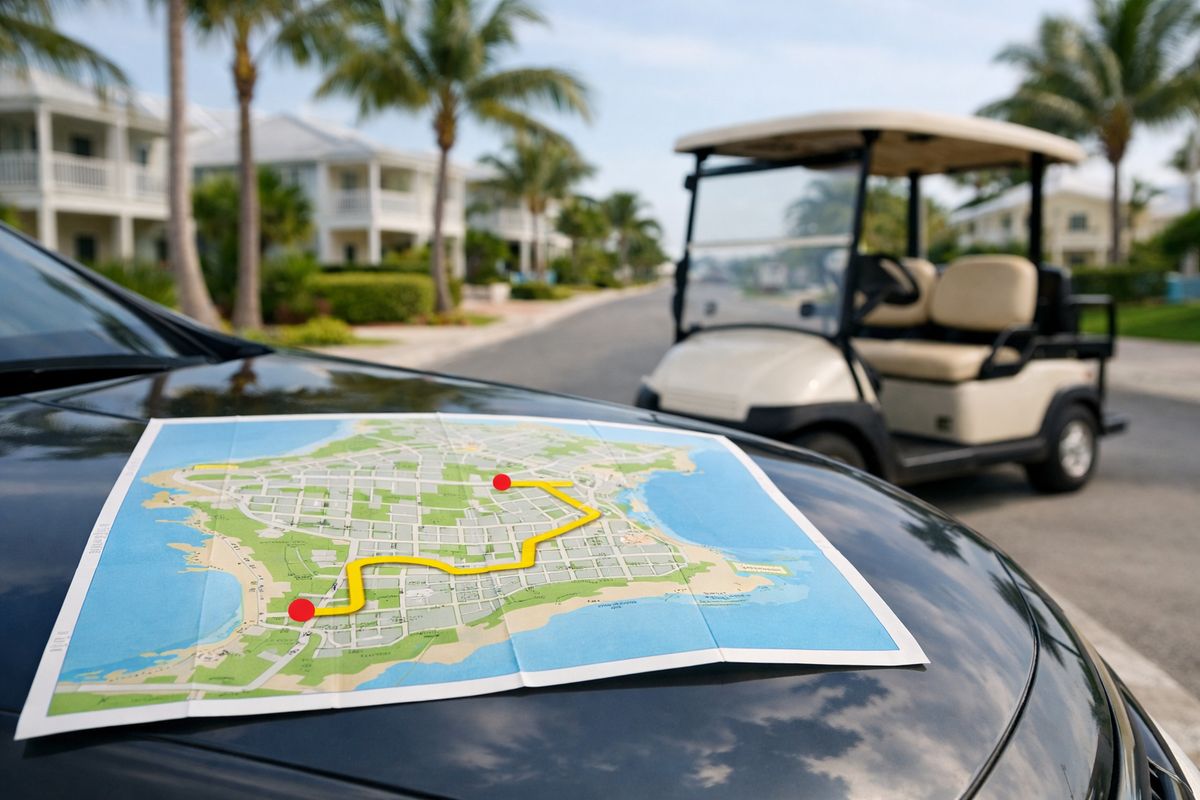
The best choice comes down to one real route, not a general idea. Take your likely vacation day, your lodging to beach access to dinner, and trace the actual roads. If that route stays short, local, and approved, a golf cart can be a fun, easy fit. If it spills onto busier roads or stretches farther than expected, pick something else.
That one quick map check can save you from choosing the wrong rental. Before booking anything, try mapping a single outing you know you’ll actually take. Once that route is clear, the right answer usually is too.